
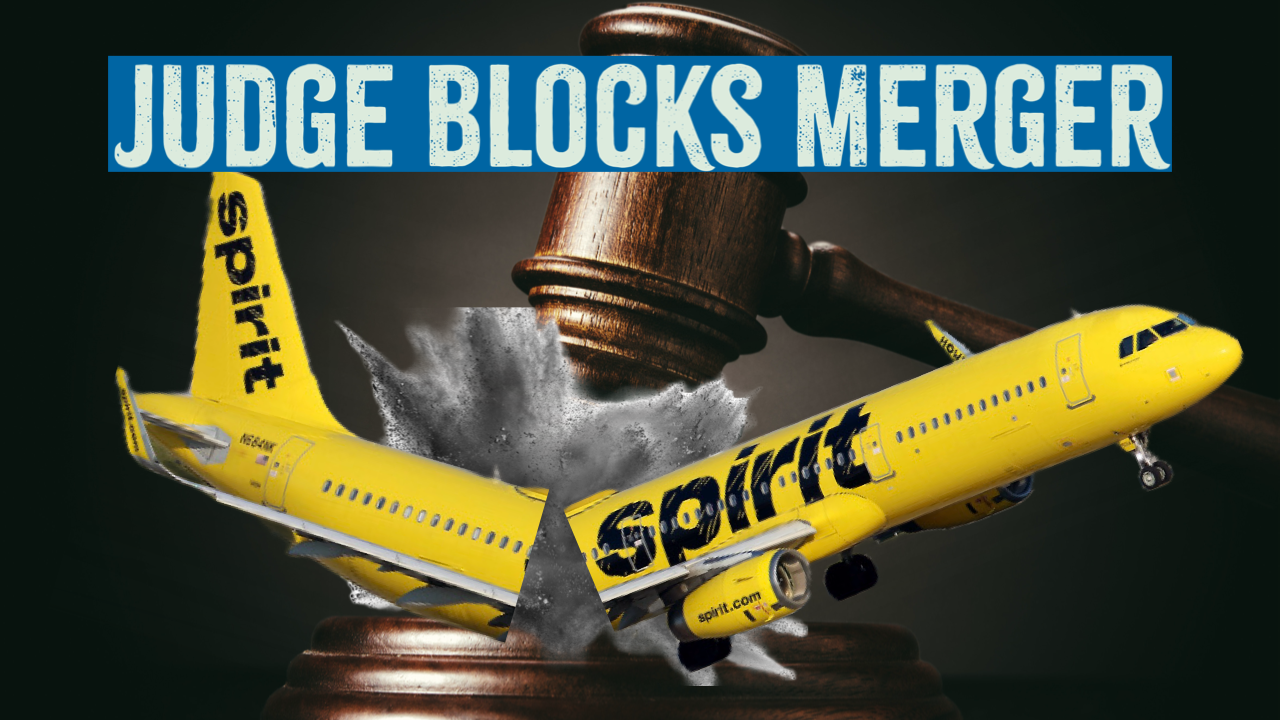

In a significant development for the aviation industry, a federal judge in Boston has ruled against JetBlue Airways’ $3.8 billion purchase of Spirit Airlines. This decision marks a major victory for the Biden administration’s Justice Department, which had sued to prevent the merger, citing concerns about potential fare increases for price-sensitive consumers.
You can read the full ruling from the U.S. District Court Judge, William G. Young, here on Axios.com website: U.S. District Court Judge Ruling: U.S. v. JetBlue Airways Corp.
The proposed merger aimed to create the nation’s fifth-largest airline, allowing JetBlue and Spirit to better compete with industry giants like Delta and United. However, the court’s ruling, based on violations of the Clayton Act, has permanently halted the acquisition.
Spirit Airlines experienced a sharp decline, with shares plummeting by 53% following the judge’s decision. The judge, William Young, explicitly ordered the airlines involved to refrain from executing the proposed merger, emphasizing the violation of antitrust regulations.
This legal saga began in July 2022 when JetBlue announced its intention to merge with Spirit, outbidding Frontier, which had initially pursued a merger with Spirit. Concerns about regulatory approval surfaced early on, and in early 2023, the Department of Justice formally challenged the merger, leading to a trial in late 2023.
While an appeals process remains a possibility, failure to overturn the decision could result in JetBlue facing a $400 million payment to Spirit as per the conditions of the agreement. This setback poses questions about the future of both airlines.
JetBlue, facing ongoing struggles, argued that a merger was essential for growth and competition. With this option off the table, the airline, under new leadership, may need to reconsider its strategies. Meanwhile, Spirit Airlines, already grappling with financial challenges and consistent losses, faces an uncertain independent future.
On October 23, 2023, Spirit Airlines, Inc. reported their disappointing third quarter (23′) financial results. According to the report, “Spirit reported a net loss of $157.6 million, or a net loss of $1.44 per diluted share.” Additionally, “Spirit reported a pre-tax loss of $203.6 million and a pre-tax margin of negative 16.2 percent.” You can view the full Spirit Airlines Reports Third Quarter 2023 Results here: Spirit Airlines Reports Third Quarter 2023 Results
What is next for Spirit Airlines and JetBlue Airways? Is there the prospect of other airlines expressing interest in acquiring Spirit? Given the regulatory hurdles faced by JetBlue, the focus could shift to ultra low-cost carriers like Frontier, as industry executives continue to stress the importance of scale for competitiveness.
As the aviation landscape navigates through these uncertainties, the blocked merger between JetBlue and Spirit serves as a reminder of the intricate legal and financial challenges airlines encounter in their pursuit of growth and market relevance.
U.S. Airlines: History of Mergers and Acquisitions:
The aviation industry in the United States has witnessed a dynamic evolution shaped by mergers and acquisitions, contributing to the dominance of major carriers. Delta Air Lines, currently the largest airline by revenue, has a history of strategic acquisitions, consolidating its position in the global market. The 2010 merger with Northwest Airlines propelled Delta to the forefront, operating an extensive network with over 250 destinations.
American Airlines and US Airways Merger
American Airlines, recognized as the world’s largest airline by fleet size, pursued a growth strategy through acquisitions. The 2013 merger with US Airways marked a pivotal moment, solidifying American Airlines’ status as the largest carrier globally. The airline’s expansion included acquisition of regional carriers like Air California in 1987 and Reno Air in 1997, shaping its comprehensive route network.
United Airlines and Continental Airlines Merger
United Airlines, another major player in the industry, claimed the title of the world’s largest airline briefly after its merger with Continental Airlines in 2012. This strategic move allowed United to leverage the strengths of both carriers, leading to increased dominance at key hubs and an extensive route expansion.
Southwest Airlines and AirTran Airways
Southwest Airlines, renowned as the world’s largest low-cost carrier, strategically expanded through acquisitions. The acquisition of Morris Air in 1993 and, more significantly, the purchase of AirTran Airways in 2010, added to Southwest’s fleet of Boeing 737 family aircraft, currently numbering around 817. These moves strengthened Southwest’s position as a dominant player in the low-cost segment.
Alaska Airlines and Hawaiian Airlines
Notably, Alaska Airlines, the fifth-largest U.S. carrier, made headlines with its historic $1.9 billion acquisition of Hawaiian Airlines. While airline mergers often result in reduced competition and lower prices, this acquisition raised concerns, particularly for the states of Alaska and Hawaii. Alaska Airlines’ expanded network now reaches into Asia and Oceania, potentially leading to increased market dominance and reduced options for travelers in these regions.
In sum, the intricate history of mergers and acquisitions in the U.S. aviation sector reflects the industry’s ever-changing landscape, with airlines continually seeking strategic partnerships to enhance their competitive edge. As the blocked JetBlue-Spirit merger adds a new chapter to this narrative, the future of airline consolidation remains a topic of keen interest, with implications for both industry players and passengers alike.



Leave a Reply